


UAE, Central Africa
Repositioning Vetifly for a Global, Multi-Audience Air Mobility Experience
Role
Lead User Experience Designer
Team
CTO, CEO, UI/ UX Designer, Design Manager, Marketing, Operations, Ground staff
Time Spent
7. 5 days ( Research to handover )
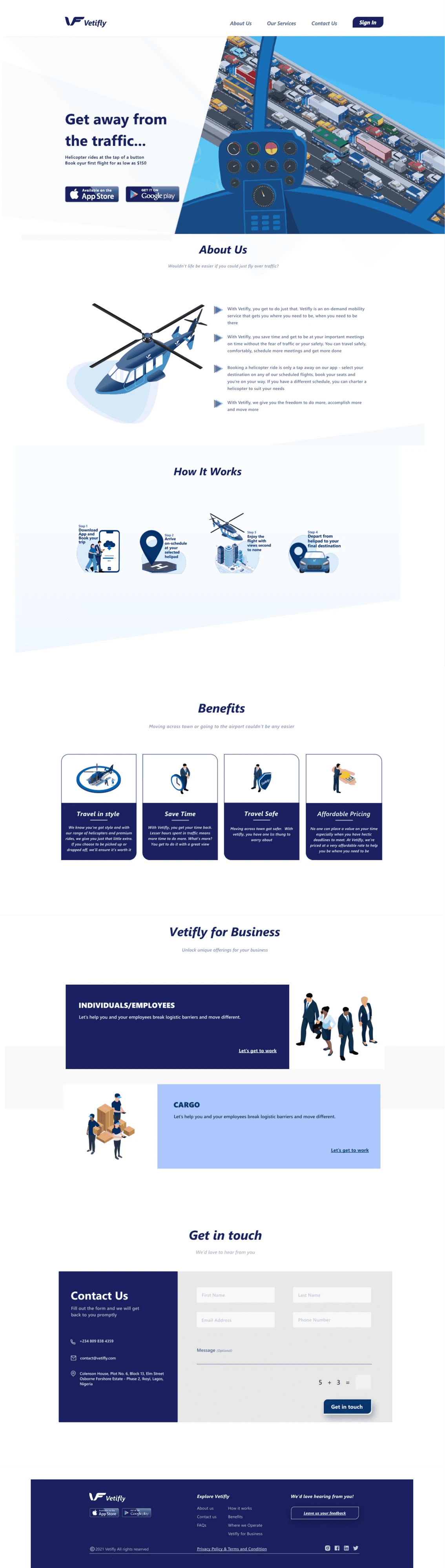
Before
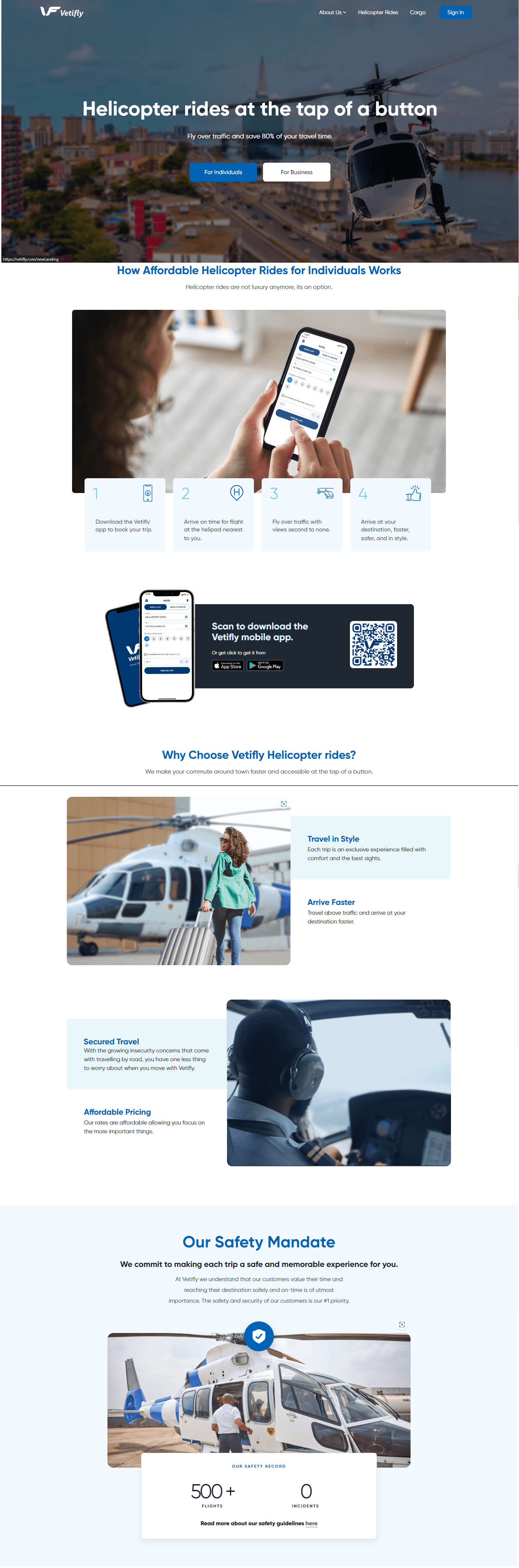
After
Overview
Vetifly was entering a growth phase — expanding its air mobility services across tourism, logistics, and premium travel. But the website lagged behind. It didn’t reflect the brand’s evolving offerings, nor did it support its expanding customer base across India and international markets. The experience was unclear, outdated, and causing a significant drop in engagement. This redesign aimed to reposition Vetifly from a niche helicopter service into a comprehensive, globally-relevant air mobility platform — one that could serve tourists, corporates, cargo clients, and high-net-worth individuals with equal clarity and confidence.
What was the problem?
The site was seeing an 80% drop-off rate. Users couldn’t grasp the breadth of services, and there was no structured way for different audience segments — tourists, corporates, or cargo clients — to navigate or take action.
Why did this need solving?
Vetifly’s expansion demanded a stronger digital front. Without a clear, credible, and globally accessible experience, it risked losing leads, partner opportunities, and user trust at the first touchpoint.
Who were we designing for?
We were building for a spectrum of users — from tourists and corporate flyers to HNIs and cargo operators. Each needed tailored information and intuitive access to services based on their goals.
Where would the impact be felt?
A successful redesign would reduce drop-offs, drive more direct inquiries, and establish Vetifly as a premium, trustworthy, and discoverable brand across international and B2B markets.
When did we intervene?
The project began at a time when Vetifly was entering new geographies, scaling partnerships, and rethinking its market positioning. It was a crucial opportunity to redesign with growth in mind.
How did we approach it?
We mapped user goals, restructured the content and information architecture, and created modular, audience-specific flows. The new website emphasized clarity, credibility, and premium service — without overwhelming users.
Research & Discovery
Why this redesign mattered
A website is often the first impression of a company. For a brand like Vetifly, which offers premium air-based transport and cargo services, trust and clarity are non-negotiable. Users were landing on the site without fully grasping what Vetifly could do for them—and leaving before taking any meaningful action. Our aim was to identify the core disconnects and build a strategy that aligned brand vision, user needs, and product value into a unified experience.
Domain research and competitive landscape?
We reviewed digital experiences from global airlines, private charter brands, and cargo solutions. This included Emirates, Blade, Lilium, WebCargo, and JSX. We noticed a common pattern—brands that invested in editorial storytelling, transparency, and user guidance performed better in both perception and engagement. This insight guided us toward a more expressive, segmented, and informative design approach—one that moved beyond transactional CTAs toward a discovery-driven, contextual journey.
Defining user needs across audiences
Through internal interviews and analytics audits, we identified five primary user segments: individual travelers, business clients, cargo partners, investors, and ecosystem collaborators. Each group had distinct expectations. Travelers wanted to compare services and pricing easily. Cargo partners needed operational details. Investors looked for team credibility and market opportunity. The existing site treated them all the same, offering generic information. We needed to design an experience that respected the diversity of these users while maintaining brand consistency.
Setting the design goals
Based on the findings, our design was guided by three core goals: Make the breadth of Vetifly’s offerings discoverable and intuitive, Deliver tailored communication to different user groups without fragmenting the brand, Reflect Vetifly’s ambition and scale through a modern, immersive, and high-performing interface.
Ideation & Concept Development
Key user goal 1: Improve content discoverability and service clarity
We started by rebuilding the information architecture from the ground up. The homepage introduced clear category entrances: Helicopter Services, Cargo Operations, Sightseeing Tours, and Private Charters. Each service had its own landing page with details, visuals, and specific CTAs relevant to that offering. This new structure helped users explore faster, understand offerings in detail, and transition more confidently into inquiry or booking flows. We also added FAQs, media mentions, and visual comparisons to aid self-service decisions. Content was reorganized with a clear narrative—what the service is, who it’s for, how it works, and why Vetifly is uniquely positioned to offer it.
Key user goal 2: Serve diverse personas with tailored experiences
Each user group experienced the site differently. For example, cargo partners now had a dedicated section with operational specs, regional availability, pricing models, and a logistics contact form. Investors could navigate to the “About” section, which housed leadership bios, sustainability initiatives, and strategic updates. We used storytelling to establish emotional and business resonance—rather than just listing features. For travelers, this meant a focus on visual journeys and ease-of-use. For partners, it meant credibility, transparency, and scale-readiness. This segmentation reduced friction and made the experience feel more intentional and aligned with their goals.
Key user goal 2: Serve diverse personas with tailored experiences
Each user group experienced the site differently. For example, cargo partners now had a dedicated section with operational specs, regional availability, pricing models, and a logistics contact form. Investors could navigate to the “About” section, which housed leadership bios, sustainability initiatives, and strategic updates. We used storytelling to establish emotional and business resonance—rather than just listing features. For travelers, this meant a focus on visual journeys and ease-of-use. For partners, it meant credibility, transparency, and scale-readiness. This segmentation reduced friction and made the experience feel more intentional and aligned with their goals.
High-fidelity interface and design system
Visually, we moved toward a modular, editorial layout that felt premium but accessible. The typography was bold yet refined. The palette was aviation-inspired—crisp blues, cloud whites, and rich blacks to represent trust, clarity, and luxury. We embedded microinteractions for actions like hovering on route cards, service comparisons, and form entry. CTAs were redesigned for clarity: "Explore Routes", "Get a Quote", "Talk to Logistics", replacing generic “Contact Us” buttons. The system was responsive, fast-loading, and built for scale—ready to support future localization, API integrations, and third-party analytics tools.
Outcomes & Impact
A strategic platform, not just a marketing site The redesigned Vetifly website didn’t just look better—it functioned as a business enabler. By clearly separating content by audience and goal, the platform reduced inquiry ambiguity and increased lead quality. More partners reached out through the cargo flow than ever before. Travelers stayed longer and explored multiple services. Stakeholders now had a credible, cohesive URL to point to—one that reflected where the company was heading, not just where it had been.
Reflections & Learnings
Designing for growth isn’t about adding more features—it’s about making sure the ones that matter are easy to see, trust, and act on.
Designing beyond UI
This project taught me that great design isn’t just about visual polish—it’s about clarity, intent, and structure. Most users didn’t bounce because the old site looked bad—they bounced because they didn’t find what they needed.
What’s Next
Mobile Experience went through a full fledged overhaul to speak brand's language and deliver an experience closely linked with service delivery. Phased primary research initiaves helped us build the mobile experience better.
Let’s Connect
"This case study shares an overview of my design process and impact at a high level. Some details have been kept brief to respect the nature of the work. If you’d like to learn more about this project or discuss my approach in greater depth, feel free to reach out—I’d be glad to share more in conversation."